
To change your results, change your state: the physiology of better outcomes
How movement, emotion, and focus rewire what's possible
To change your results, change your state: the physiology of better outcomes
Most people don't fail because they lack discipline. They fail because they ask the wrong questions. And they ask them in the wrong state. Your state is your physiology: how you're breathing, how you're moving, the tension in your body, and the emotions running through your nervous system.
State comes first: e-motion = motivation
Motivation does not start in your mind.
It starts in your body and nervous system.
You must move and you must speak to change your state.
Use:
movement + passionate spoken affirmations
to enter your desired state.
If your state is:
"I can do this."
You are ready to begin.
This is where the word e-motion comes from:
emotion + motion.
You are physically moving.
You are emotionally engaged.
You are changing your physiology.
You are not just "thinking differently."
You are creating a different internal environment for thinking.
Why movement + spoken affirmations work
Movement and affirmations change both your mind and your body.
When you go for a morning run or a walk to start your day or even do some exercise at home:
• your brain chemistry shifts (more mood-boosting chemicals, less stress hormone)
• your nervous system moves from threat → action
• rumination decreases
When you say affirmations out loud with emotion:
• your brain treats them as important
• learning sticks more deeply
• belief patterns begin to rewire
Emotion makes learning stick.
Beliefs are not just thoughts.
They are stored in the nervous system as habits of:
• feeling
• breathing
• reacting
So to change beliefs, you must change state.
By combining:
• movement
• spoken words
• emotional intensity
• repetition
you create a new internal state.
And that state leads to:
better thinking →
better actions →
better outcomes.
In short:
Change your state → change your beliefs → change your behaviour → change your results.
Then focus: outcome → what → why → how
Once your physiology is working with you (not against you), you can plan clearly.
Start here:
What is the specific result I am trying to create? (Outcome)
Why? (your compelling purpose — the emotional why)
What questions do I need to ask to get there? (How)
Who do I need to speak to make this happen?
What do I to ask them to make this happen?
What do I need to do to make this happen?
What do I need to learn?
This takes you to your MAP
What is my Massive Action Plan (MAP)?
This is your strategic roadmap.
So the structure becomes:
Outcome → What (what is my purpose) Why → (all the reasons I am doing this - the emotions) → How (questions, the MAP + roadmap)
You don't do this once and forget it.
You focus on the result or outcome every day.
And you ask the questions every day. What will move you forward the most toward that outcome.
Because focus is not a one-time decision.
It is a daily practice.
Each day, from a regulated state, you return to:
What outcome am I creating?
Why does it matter today?
What questions do I need to ask now?
Who could help me move this forward?
What is the next right action?
This is how direction stays alive.
Take time out: 3 hours or 3 days
You can work very hard at being busy…
in the wrong direction and achieve none of your outcomes.
Taking even three hours — or three full days —
to reset your state, ask the right questions, and create your MAP
can change your entire trajectory.
Step away from the noise.
Move your body.
Regulate your nervous system.
Then ask:
What outcome do I want to create?
Why does this matter to me emotionally?
What questions do I need to ask to get there?
Who do I need to speak to?
What do I need to learn?
What would my future self do first?
Only then do you build your Massive Action Plan (MAP)
and your strategic roadmap.
To do this you put your outcomes in order including why
Look at all the options on how to get there
Look at the consequences of each of the options
the probability of each of them
And how you can mitigate and resolve
This is what Tony Robbins calls Rapid Planning: a purpose-driven planning system that shifts focus from reactive to-do lists to desired results, using three core questions: What is the Result I want?, What is my Purpose (Why)?, and What is my Massive Action Plan (How)?
Not rushed.
Not reactive.
Not done in panic.
It is done in a reset state.
You change your physiology first.
Then you change your focus.
Then you change your direction and your life.
The brain responds to imagined experiences as if they're real
When you vividly imagine a future scenario,
neural networks in your brain activate in a way that closely resembles real experience.
This is well documented in:
• mental rehearsal research (used by athletes, musicians, surgeons)
• MRI studies showing overlap between imagination and perception
When your body is in a regulated, empowered state,
visualising a desired future changes your brain's expectations of what's possible
and makes aligned behaviour feel more natural.
Your brain begins preparing for the life you are rehearsing.
The reticular activating system (RAS)
Your brain filters reality through the Reticular Activating System.
It decides what information is relevant.
Your focus programs it.
When you write or speak in the direction you're headed:
"I am creating…"
"I feel…"
You give your brain a target.
You start:
• noticing opportunities you ignored before
• filtering out distractions
• biasing choices toward the outcome you described
This is not mystical.
It is selective attention plus goal priming.
And it works best when your nervous system is not in survival mode.
"This Is Who I Am Becoming"
This is called self-signaling.
Your actions signal identity.
Identity shapes behaviour.
Research shows that identity-based goals
("I am someone who…")
are often more powerful than outcome goals
("I want to…").
When you repeatedly enter a powerful state
and take aligned action,
you reinforce an identity that says:
This is who I am now.
Behavioural activation (where change becomes real)
The real effect of all this is behavioural.
When your physiology is regulated
and your focus is clear,
you are more likely to:
• send the message
• apply for the job
• say yes to the opportunity
• leave what is holding you back
• practice the skills
State → focus → behaviour → outcome.
That is the loop.
Key Takeaway
You don't need a perfect day. You need a repeatable reset.
Every day — especially when you feel stuck — do this:
1) Move Walk, stretch, shake it out, run — even 2 minutes.
2) Speak your future out loud Use affirmations with emotion. Change your physiology first.
3) Focus on the outcome What am I creating?
4) Ask better questions What do I need to learn? Who do I need to speak to? What is the next right step?
5) Take the next right action
That is the loop:
Move → affirm → outcome → questions → action.
Do this daily and it becomes a habit. And habits become results.
That is how change becomes real.
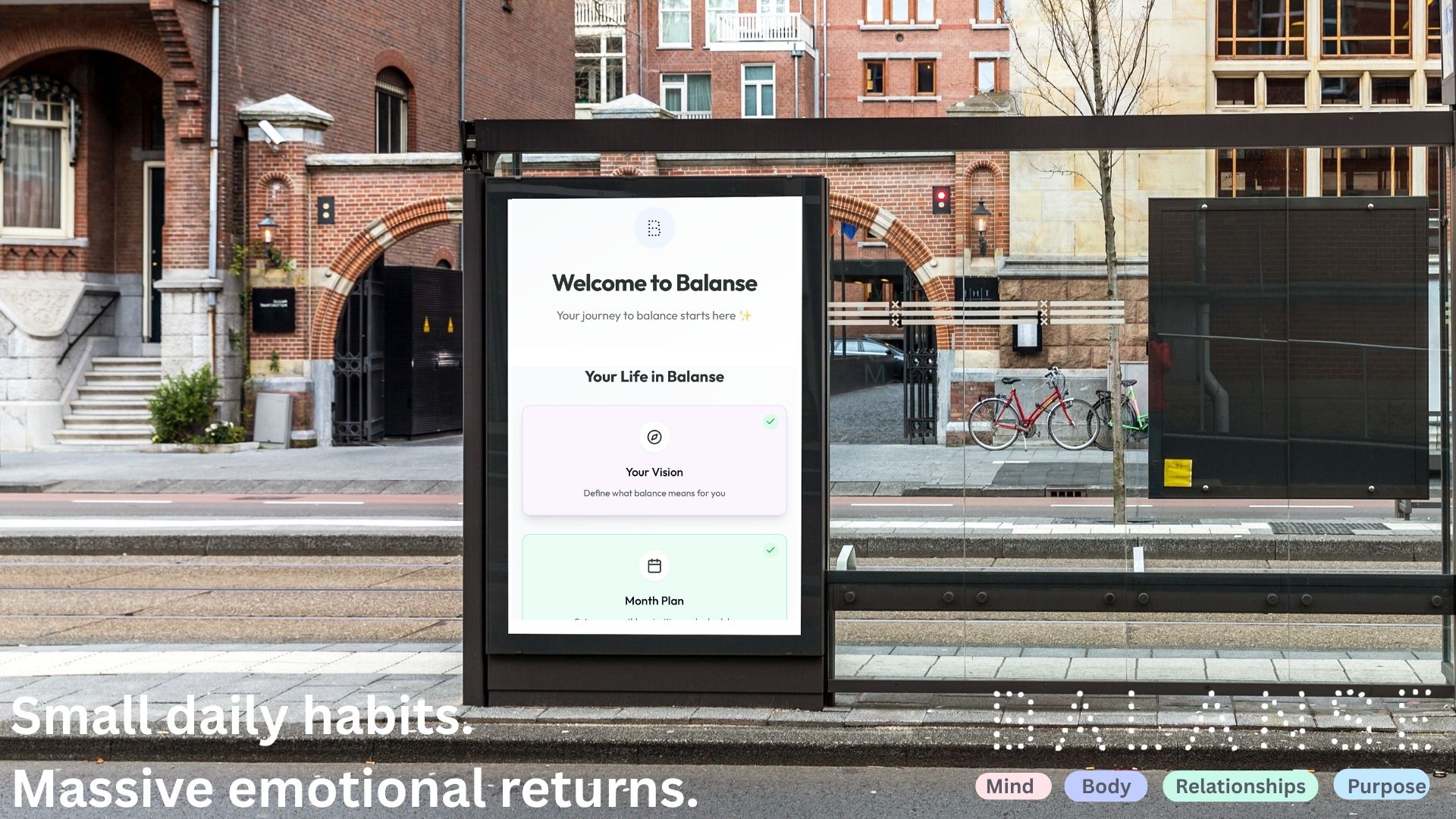
Small daily habits.
Massive emotional returns.
Everything you need to create a life of balance, purpose and fulfilment. Sign up today.