
Does therapy actually work?
More people are in therapy today than at any point in history.
Does therapy actually work?
More people are in therapy today than at any point in history. And yet despite the growth of therapy, levels of burnout, anxiety, depression and stress continue to rise. If so many people are in therapy, why do so many still feel stuck?
Therapy can help — but only if something changes
Therapy can be incredibly valuable. Research consistently shows that around 50–75% of people experience some improvement through therapy, particularly with symptoms such as anxiety and depression. But improvement doesn't always mean transformation. For many people, therapy becomes a place to understand their problems rather than change how they live.
You talk about your past. You analyse patterns. You unpack childhood experiences. You explore difficult emotions. And awareness matters. But awareness alone rarely changes a life. Real change happens when something shifts in how you think, act and show up in the world. When habits change. When behaviours change. When daily patterns change.
Without that, therapy risks becoming something else: a place where you understand your problems better but continue living the same life.
The cycle many people get stuck in
It's surprisingly common for people to stay in therapy for years without fundamental changes to their day-to-day lives. They become more self-aware. They understand their triggers. They can explain their anxieties clearly. But the core behaviours remain the same. The habits don't change. The environment doesn't change. The routines don't change. Which means life often continues to feel the same too. This isn't because therapy is inherently ineffective. It's because understanding the problem is only the first step. The second step — the one many people struggle with — is action.
The affordability problem
There's another issue that's becoming impossible to ignore. Therapy is increasingly unaffordable. In the US, therapy often costs $100–$200 per session.
In the UK, private therapy typically costs £60–£120 per session, which can easily become £250–£500+ per month for weekly sessions. For many people, that simply isn't sustainable. At the same time, public systems are overwhelmed, with waiting lists stretching for months or even years. Which leaves millions of people in a difficult position. They know something in their life needs to change. But they don't have accessible daily tools that help them actually create that change.
The real problem: living out of alignment
For many people, the deeper issue isn't severe trauma or mental illness. It's something quieter. A life that slowly drifts out of alignment. You might recognise the feeling.
Chaos. Burnout. Stress. Spinning plates. Too many demands. Low energy. Constant noise. Distraction. Self-criticism. Overthinking. Back pain. Body tension. ADHD overwhelm. Trying to keep everything together. You're functioning. But you're not thriving. You're surviving. And often, from the outside, everything still looks "fine."
What actually changes a life
One of the most powerful insights from psychology and behavioural science is this:
Identity is shaped through action. Not through thinking alone. When you move your body, your physiology changes. When you shift your habits, your brain rewires. When you change your focus, your experience of life changes too. In other words: transformation happens when your daily behaviour changes. Not through occasional breakthroughs. But through repeated daily action.
Small behavioural changes repeated consistently can improve mood, increase resilience, strengthen wellbeing and gradually reshape identity over time.
Which means real change rarely comes from endlessly analysing your problems. It comes from living differently.
Reconnecting with yourself
Often the deeper work is not endlessly trying to "fix" yourself. It's reconnecting with yourself. Asking simpler questions:
What makes me feel alive? What gives me energy? What brings me back to myself? What kind of life actually feels true to me? The answers are often surprisingly simple. Movement. Nature. Meaningful work. Creativity. Connection. Helping other people. Rest. Purpose. These things remind us that we are not simply problems to solve. We are human beings designed to grow, create, connect and contribute.
Living in alignment
The deeper question isn't simply: "How do I feel better?" It's: "Am I living in alignment with who I really am?"
Are your days aligned with your values? Are you using your energy in ways that matter to you? Are your habits supporting the life you actually want?
When those things are missing, life can feel strangely empty even when everything appears successful from the outside. This is where many people are today. Not broken. Just disconnected from themselves.
A different approach
This is exactly why I created Balanse. Not as therapy. Not as another productivity app. But as a simple daily system to help people move from drift to alignment. Balanse helps people move through five stages:
Drift → Reset → Design → Systems → Alignment First you recognise the drift. Then you reset and understand where you are. Then you design the life you actually want. Then you build simple systems and habits that support it. Eventually, your life becomes more aligned with what matters most. At the centre of it is a simple daily practice: a daily reset. A moment each day to reconnect with your purpose, your energy and the actions that move your life forward.
Because real change doesn't happen in occasional breakthroughs. It happens in the way you live your days. And your day creates your life.
A simple place to begin
If your life feels slightly out of alignment, you don't need to have everything figured out before you begin. You just need a place to start.
Take the Balanse Reset — a short 42-question diagnostic designed to help you understand where you are right now. Then try one of the challenges. Build a few small habits. Start creating days that reflect the life you actually want to live. Because understanding your problems is only the first step. Living differently is what changes everything.
And that starts with one simple decision: to move out of your head and into action. We don't need more information. We need more transformation.
Key Takeaway
Understanding your problems is only the first step. Living differently is what changes everything. We don't need more information. We need more transformation.
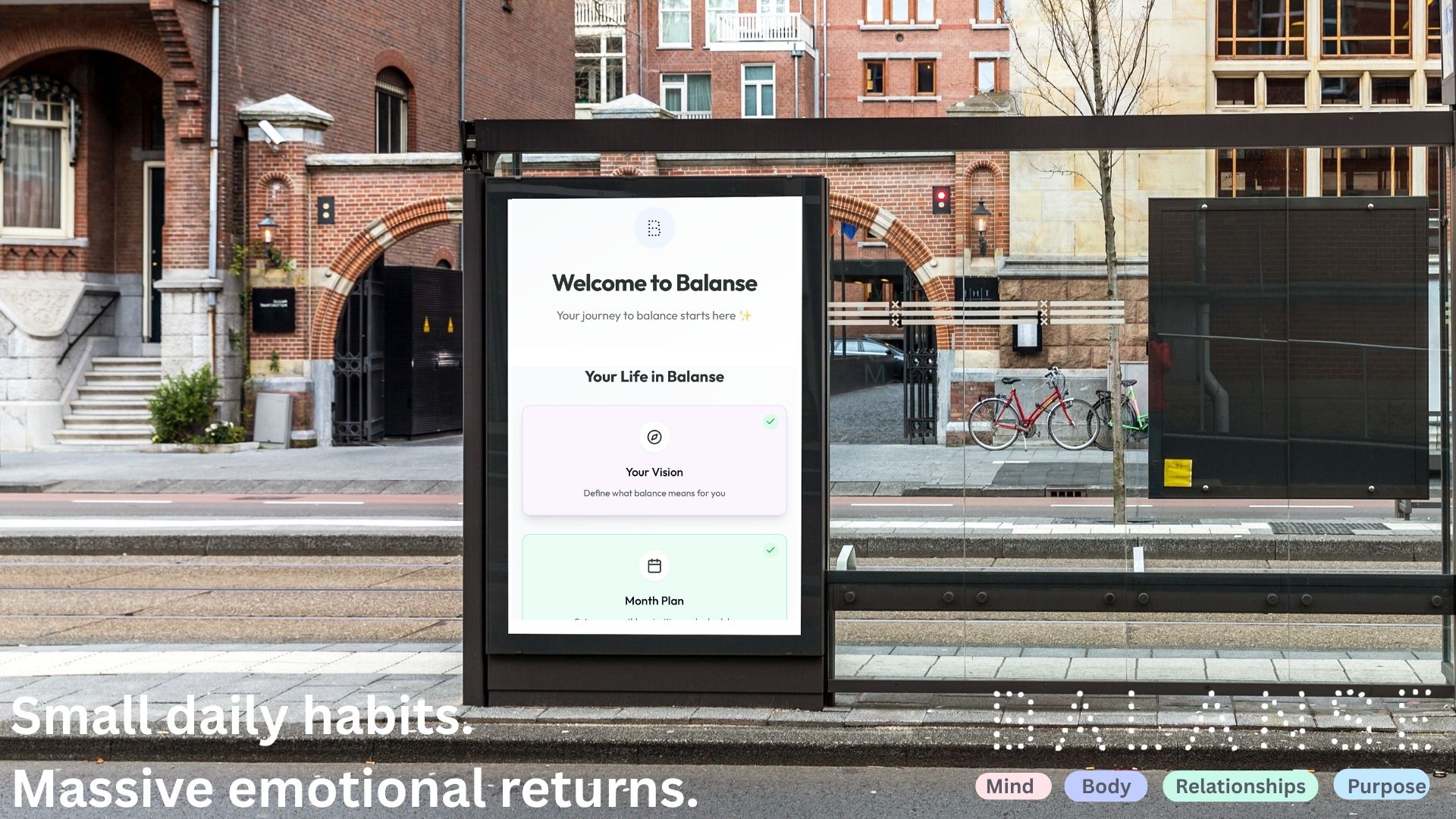
Small daily habits.
Massive emotional returns.
Everything you need to create a life of balance, purpose and fulfilment. Sign up today.