
The hidden cost of being "fine"
The most dangerous place to be in life isn't unhappy - it's fine.
The hidden cost of being "fine"
"Until you make the unconscious conscious, it will direct your life and you will call it fate." - Carl Jung. Lately, I've been noticing how often conversations start and end the same way. "How are you?" "I'm fine."
What "fine" actually is
"Fine" sounds neutral. Harmless, even.
But most of the time, it's not an accurate description. It's a shortcut.
A way of compressing complex emotions into something socially acceptable.
A way of avoiding deeper conversations.
A way of moving on quickly instead of pausing long enough to ask:
What am I actually feeling right now?
Psychologists sometimes describe this as emotional compression. When we simplify our emotional experience into a single neutral label, we lose access to the information our feelings are trying to give us.
Emotions are signals.
They tell us what matters to us.
What needs attention.
What needs to change.
When everything becomes "fine," those signals slowly become quieter.
And over time, we stop hearing them.
The problem isn't the word itself.
The problem is what it slowly replaces.
1. It makes you lose touch with what you actually feel
"Fine" is often what we say when we don't have the space or safety to say more.
But when every emotion gets translated into "fine," something subtle happens. You stop checking in with what's really there.
Not just the difficult emotions, but the positive ones too.
Excitement. Curiosity. Pride. Gratitude. Joy.
All of them become flattened into the same neutral response.
Psychological research shows that emotional awareness is strongly linked to wellbeing. The more precisely we can identify our emotions, the better we are able to regulate them.
But when everything becomes "fine," emotional awareness slowly fades.
→ The more often you say "I'm fine," the less you actually notice how you are.
2. It keeps you in place longer than you need to be
Your routine is fine.
Your work is fine.
Your relationships are fine.
Nothing feels urgent enough to change.
But nothing feels meaningful enough to fully engage with either.
So you stay where you are.
And over time, in that in-between space, something subtle begins to happen.
You lose touch with what would actually feel good.
What excites you.
What energises you.
What you might want that's different or more.
The desire doesn't disappear.
It simply becomes quieter.
→ "Fine" keeps life stable, but it can also keep it small.
3. It puts you on autopilot and softens your curiosity
When everything feels "fine," you stop paying close attention.
You move through your days on autopilot. The choices feel familiar, so you don't revisit them.
And slowly, the questions that once guided you become quieter.
Questions like:
What is no longer working?
What do I actually want?
What would make my life feel more meaningful?
Curiosity needs a small amount of friction.
A sense that something could be explored, improved, or changed.
But when everything feels "fine," the motivation to explore disappears.
→ "Fine" keeps life running, but it also keeps you from fully living it.
4. It disguises itself as strength
"Fine" can sound very reasonable.
"I'm okay."
"I'll deal with it."
"It's not a big deal."
And sometimes, that really is resilience.
But sometimes it's something else.
Sometimes it's the instinct to minimise what you feel.
To avoid disruption.
To not make things complicated.
To keep everything steady.
It looks like strength from the outside.
But internally, it can be a quiet form of avoidance.
Real resilience doesn't ignore emotions.
It acknowledges them and then decides how to move forward.
→ Sometimes "fine" isn't acceptance. It's hesitation disguised as stability.
5. It keeps your relationships on the surface
This might be where it matters most.
When "fine" becomes your default answer, conversations stop there.
People ask.
You respond.
And the moment passes.
What doesn't happen is the part that creates connection.
The moment where you say a little more.
Where someone understands you a little better.
Where something real is shared.
Not every conversation needs depth. And not every moment needs vulnerability.
But if everything stays at "fine," something important gets missed.
Human beings are social creatures. Psychological research consistently shows that meaningful relationships are one of the strongest predictors of wellbeing and life satisfaction.
And meaningful relationships require something beyond "fine."
→ "Fine" protects you from vulnerability, but it also keeps you from living an intentional life.
The alternative to "fine"
The alternative isn't oversharing.
It isn't analysing every emotion.
It's something much simpler.
Awareness.
Just pausing for a moment and asking yourself:
How am I actually feeling today?
Not the socially acceptable answer.
The real one.
Because the moment you become aware of how you feel, something shifts.
You move from autopilot to intention.
And that's where change begins.
A simple question for today
So the next time someone asks:
"How are you?"
You don't have to give a long answer.
But maybe, just for yourself, pause for a moment before you reply.
Ask the quieter question underneath it.
How am I really doing today?
Because the life you build isn't created in big, dramatic moments.
It's created in the small moments when you notice what's actually going on.
And choose to live with intention. Because your day creates your life.
Key Takeaway
"Fine" isn't really a feeling. It's a filter. And when you look at your life through that filter for too long, it starts to quietly limit everything - your emotions, your relationships, your growth. The alternative is simple: awareness. Just pausing long enough to ask yourself how you actually feel. Because the life you build is created in the small moments when you notice what's actually going on.
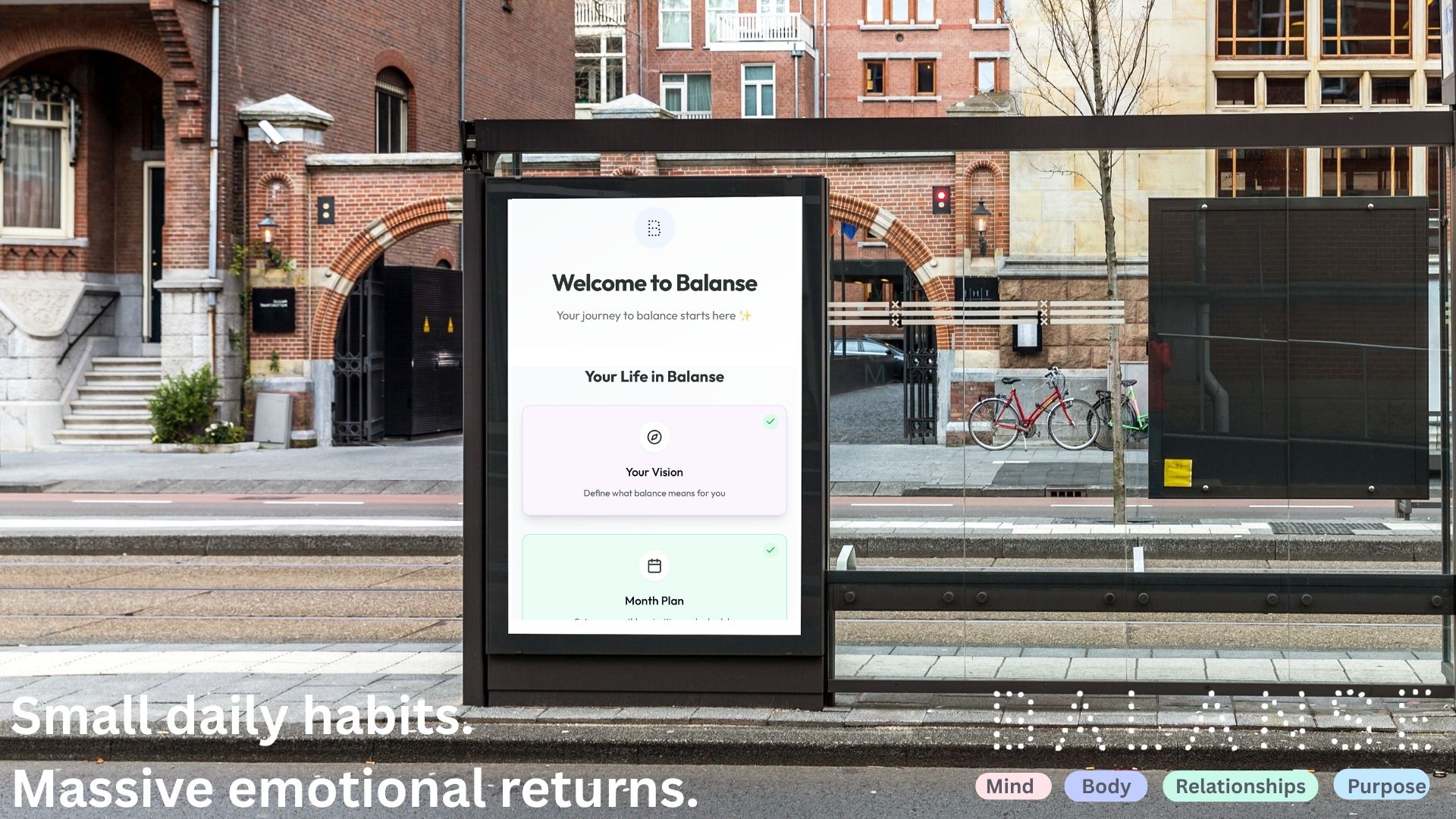
Small daily habits.
Massive emotional returns.
Everything you need to create a life of balance, purpose and fulfilment. Sign up today.