
How do you know if it's a sign?
People often say they're waiting for a sign.
How do you know if it's a sign?
A sign to leave the job, start the business, end the relationship, move to a new city, or finally pursue the thing you can't stop thinking about. The problem is that most people are waiting for certainty. And signs rarely arrive that way.
Signs arrive quietly, through repetition
In my experience, a sign is rarely a booming voice from the universe telling you exactly what to do. It's usually much quieter than that. More subtle. More persistent.
It's often a feeling that keeps returning. An idea you can't seem to let go of. A conversation that lands differently. A book that says exactly what you needed to hear. A thought that keeps showing up despite your best efforts to ignore it.
The interesting thing about signs is that they often arrive through repetition.
The same message appears in different places. Different people give similar advice. Opportunities emerge around the same theme. You notice the same idea showing up again and again.
At first, it feels like coincidence. Then it begins to feel like a pattern.
Patterns matter because our lives are often shaped by what we repeatedly notice and what we repeatedly avoid. Sometimes the sign isn't what keeps showing up around you. Sometimes it's what keeps pulling at you from within.
Many of us have experienced that quiet internal nudge. The recurring sense that there is something we should do, explore, create or change. It doesn't disappear when we're busy. It doesn't disappear when we distract ourselves. It patiently waits and returns.
The longer we ignore it, the louder it often becomes.
Intuition: your body knows before your mind does
This is where intuition enters the conversation.
Intuition is often misunderstood as something mystical. In reality, intuition is frequently your brain and nervous system processing information before your conscious mind has caught up.
Your body notices patterns long before your thinking mind can explain them.
Research suggests that emotional processing happens incredibly quickly, while conscious awareness takes longer. Your nervous system is constantly scanning your environment, comparing experiences to everything you've learned throughout your life.
This is why you sometimes know something feels right before you can explain why. It's also why you sometimes know something feels wrong before you have evidence to support it.
Your body often knows before your mind does.
Have you ever walked into a room and immediately felt uncomfortable without knowing why? Or met someone and instantly felt at ease? Or felt a deep sense of excitement about an opportunity that made no logical sense at the time?
These physical responses are data. Not instructions, but data.
Distinguishing intuition from fear
The challenge is learning to distinguish intuition from fear.
Fear tends to be loud, urgent and chaotic. It catastrophises. It creates panic. It demands immediate action.
Intuition is usually quieter.
It often arrives as a calm knowing, a sense of clarity, or a persistent feeling that something deserves your attention. It may still feel uncomfortable because growth is often uncomfortable, but it doesn't usually feel frantic.
That's an important distinction.
Sometimes people mistake fear for a sign to stop. In reality, fear is often present whenever we are about to grow.
The question isn't whether you're scared. The question is whether the fear is protecting you from genuine danger or simply protecting you from uncertainty.
When life feels too small
So how do you know when it's time to try something new?
Often the first clue is that your current life starts feeling too small for who you're becoming.
You may feel restless. The work that once excited you no longer energises you. You find yourself daydreaming about different possibilities. You notice a growing sense of dissatisfaction, even when everything looks fine on the surface.
This is what I often call drift.
From the outside, life appears successful. You're functioning. You're delivering. You're doing all the things you're supposed to do.
But underneath, something feels off. You can't quite explain it. You simply know.
Take a small step. Action creates clarity.
Many people ignore these feelings for years because they think a major life change requires a dramatic decision. It usually doesn't.
The best way to test whether something is a genuine sign is not to make a massive leap. It's to take a small step. Apply for the course. Have the conversation. Write the first page. Launch the first version. Make the phone call. Block out the time. Then see what happens.
Starting small removes much of the pressure. It transforms uncertainty from something you need to solve into something you can explore.
You don't need to know exactly where the road leads. You simply need to take the next step and pay attention. Do you feel more alive, more energised, more aligned? Or does the path continue to feel heavy and forced?
The answer often reveals itself through action, not thinking.
Most signs only make sense in hindsight. When we look back, we can see the clues, the patterns, the nudges and the opportunities that were trying to get our attention. At the time, they rarely felt obvious. They felt like curiosity. Like possibility. Like a quiet voice asking, what if?
Key Takeaway
If there's something you've been thinking about for months or even years, something that keeps returning no matter how often you dismiss it, perhaps that's worth paying attention to. Not because it's a guaranteed path, and not because it's risk-free, but because life has a strange way of guiding us toward what we're ready for next.
You don't need certainty. You need curiosity.
You don't need a giant sign. You need the courage to trust the small one and then take the next step.
Because clarity rarely comes before action. More often, action creates clarity.
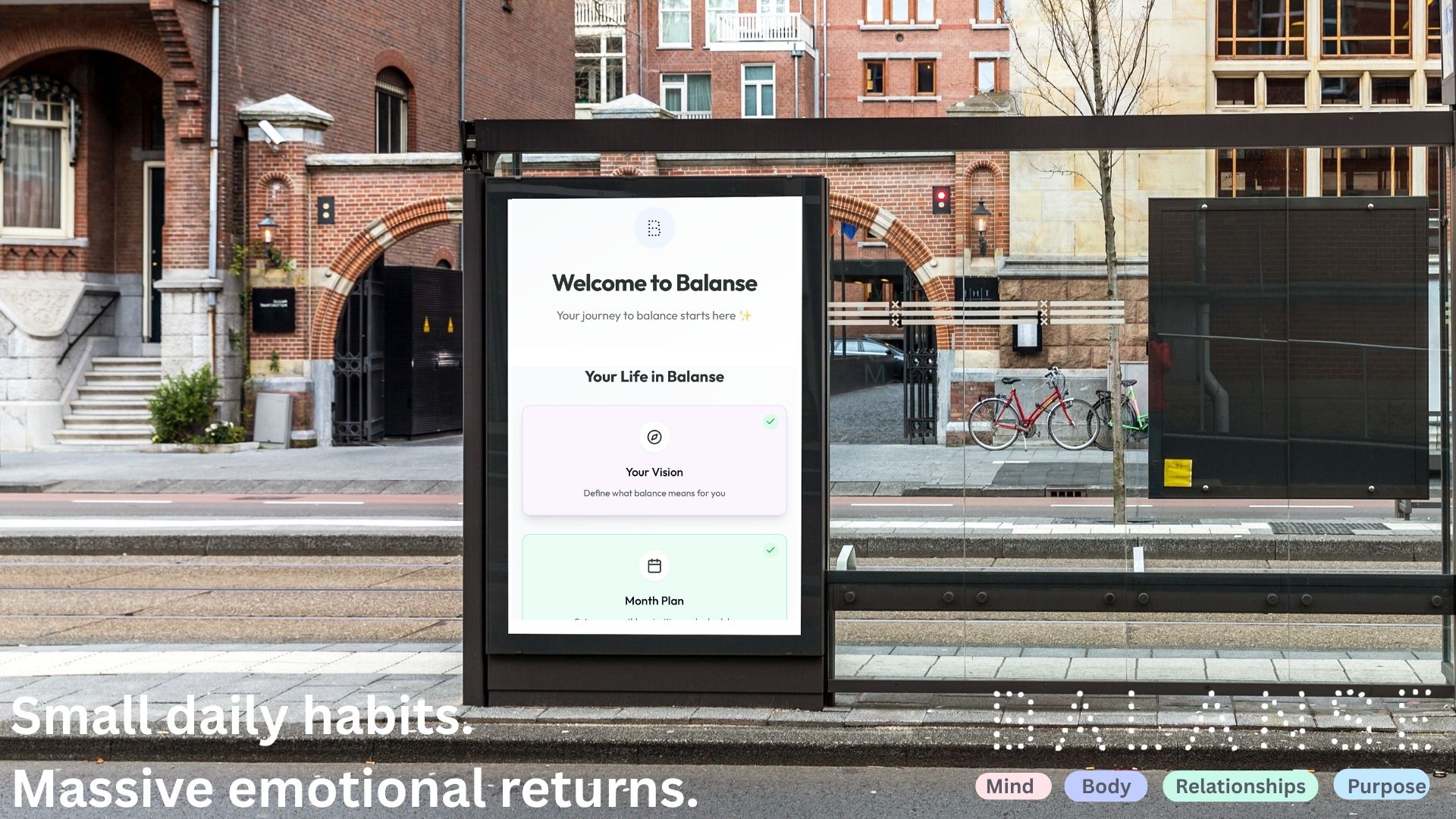
Small daily habits.
Massive emotional returns.
Everything you need to create a life of balance, purpose and fulfilment. Sign up today.