

The science of momentum: why taking the first step changes everything
Most people believe progress requires a perfect plan.
The science of momentum: why taking the first step changes everything
Research in psychology and behavioural science shows that momentum is created through action - not planning. And the biggest barrier to action is not laziness. It's state.
The real starting point: your state
Your ability to take action depends heavily on your physical and emotional state.
Neuroscience shows that when your nervous system is stressed or overwhelmed:
Focus decreases
Creativity drops
Decision-making weakens
Your brain moves into survival mode.
But when your physiology changes - your breathing, posture, and movement - your brain chemistry changes too.
This is why movement precedes clarity.
Action changes your state.
Your state changes your thinking.
The 3 drivers of momentum
Peak performance research consistently points to three forces that shape behaviour:
Physiology
How you use your body influences how you think and feel. Get up, do some star jumps - get into a peak state.
Focus
Where you direct attention determines what your brain prioritises. Then decide what you're going to focus on today.
Meaning
The meaning you assign to events shapes emotional response and behaviour. If you decide that not being where you are in life is because you are not good enough, then you are reinforcing the belief that you are not good enough. If you flip this to mean you are learning something new every day that takes you one step closer - you assign progress as your meaning and progress = happiness, you feel amazing.
These three elements constantly interact.
Change one - and the others begin to shift.
Why most people never start
Many capable people delay action because they believe they need:
Certainty
The perfect plan
The right timing
But momentum works differently.
Momentum is created through movement.
Even a small action changes the psychological equation.
It:
Reduces uncertainty
Increases confidence
Reveals new opportunities
Clarity often appears after movement, not before.
The momentum loop
Progress follows a simple cycle:
Change your state > Direct your focus > Take action > Measure your results > Gain confidence > Take more aligned action
Each step reinforces the next.
But the loop must start somewhere.
That first step - even a small one, breaks the inertia.
The power of immediate action
One of the most effective strategies for creating momentum is simple:
Take one action immediately.
Before your brain has time to rationalise delay.
It might be:
Sending the message
Writing the plan
Going for a walk
Scheduling the conversation
Starting the first task
Urgency creates energy.
And energy creates momentum.
Momentum builds confidence
Confidence does not come before action.
It comes from action.
Every completed step sends a signal to your brain:
"I am someone who moves forward."
Repeated often enough, that identity becomes real.
And identity drives behaviour.
The real secret to progress
Most people wait for motivation.
But motivation is unreliable.
Momentum is different.
Momentum compounds.
The more you move, the easier movement becomes.
Key Takeaway
If you feel stuck, don't try to redesign your entire life. Start smaller. Ask: What is the next right action? Then take it. Momentum begins with movement.
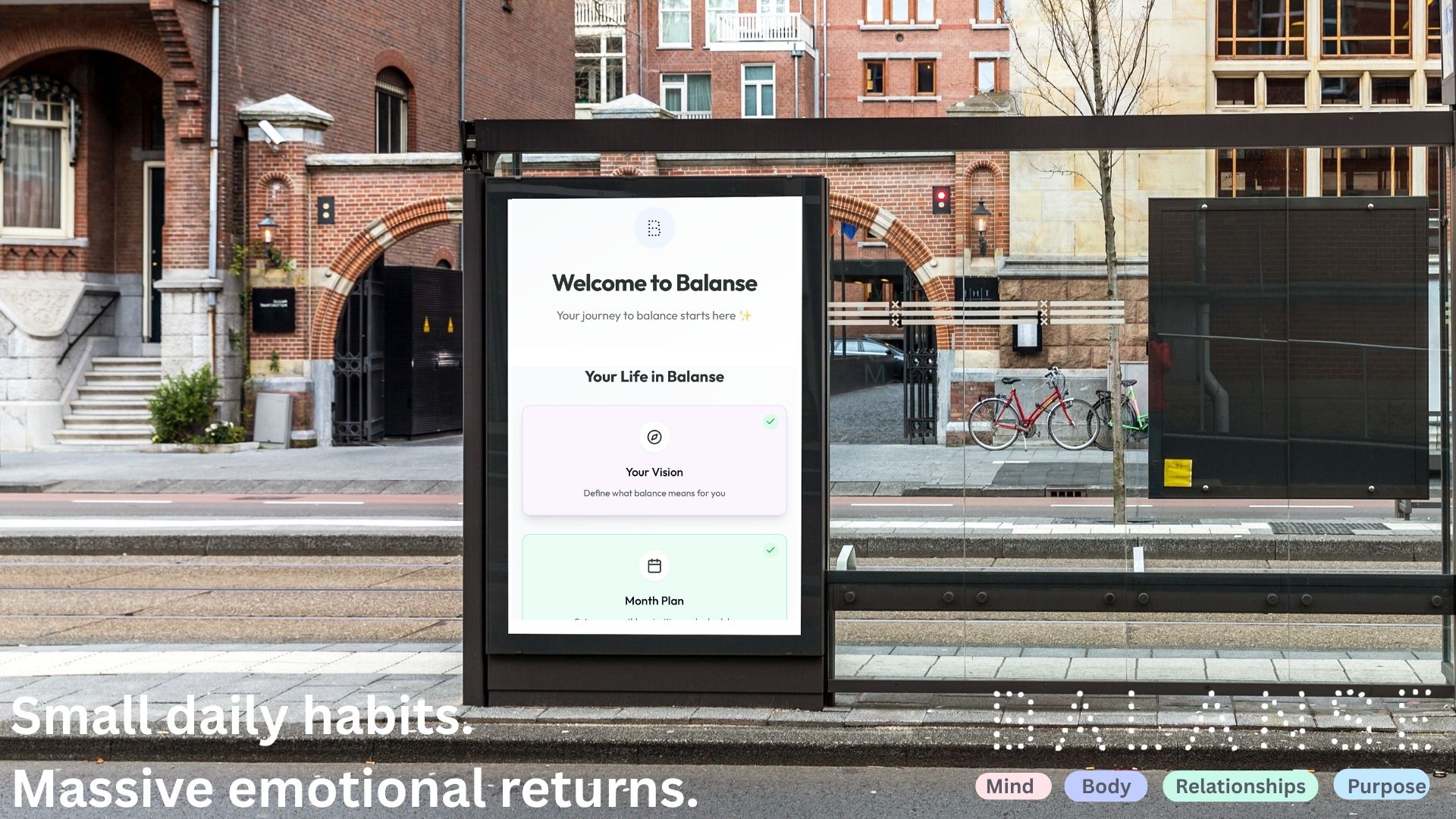
Small daily habits.
Massive emotional returns.
Everything you need to create a life of balance, purpose and fulfilment. Sign up today.