
Status quo bias — why "fine" is the most expensive choice you make
Behavioural economists have spent decades documenting a quiet distortion in how we make decisions.
Status quo bias — why "fine" is the most expensive choice you make
Faced with a choice between changing and staying the same, we almost always overweight the cost of changing — and underweight the cost of staying. It's called status quo bias.
The cost of staying is invisible — which is exactly why it wins
A vivid, immediate cost will always beat a silent, distant one. That's not a willpower failure. It's how the machinery works. The risk of changing shows up loud and now; the risk of staying shows up quietly, later, as a slow accumulation you never quite notice.
So let me make the invisible cost visible, because that's the only thing that changes the maths. It shows up in two places I want to name.
The tolerance trap
Most people don't get stuck because they lack ambition. They get stuck because they lower their minimum standards — not consciously, gradually.
You tolerate slightly worse sleep. You tolerate slightly more stress. You tolerate conversations that drain you. You tolerate work that no longer excites you. You tolerate a relationship that feels "fine."
Nothing collapses dramatically. It just erodes. And here's the line: you don't rise to your goals — you fall to your standards. Whatever you're willing to tolerate becomes your life.
The autopilot effect
Your brain is built to conserve energy. Once a pattern is familiar, it runs on autopilot — same routines, same responses to the same pressures. Efficient, yes. But it also means you stop noticing when something has quietly stopped working.
So the days run on a track you laid down years ago, for a version of you that's moved on. That's how success hides drift. From the outside, everything's handled. Inside, you've gone numb to a life you never actually chose.
"Not that bad" becomes your ceiling
Listen to how status quo bias actually sounds in your own head, because you'll recognise it:
It's not that bad. Other people have it worse. This is just adulthood. I should be grateful.
Every sentence is reasonable. And slowly, "not that bad" stops describing a hard season and becomes the ceiling on your whole life.
That's why I say the most dangerous place to be isn't unhappy — it's fine. Unhappy moves you. Fine doesn't. Fine just keeps you tolerating, one small concession at a time, while the years quietly spend themselves.
Flip the calculation
So do the thing your brain refuses to do on its own — make the silent cost loud.
Don't ask what it would cost to change. Ask, honestly, what it will cost to stay. Not next week. Three years from now. Five. Ten. Where will you be if you keep waiting? What will you have quietly lost? What will it feel like to be carrying the exact same restlessness a decade older?
Once you can actually see that cost, the maths changes. Because the question was never is changing risky. The real question is which risk you can live with — the loud one in front of you, or the silent one already running.
Nothing has gone wrong
If you've recognised yourself in every line of this, hear it clearly: nothing has gone wrong. You didn't fail. You adapted — and adapting is what capable people do. The restlessness isn't a fault. It's the part of you that never agreed to call "fine" the finish line.
This isn't reinvention. You don't need to become someone new. It's recalibration — and it starts by deciding from here, not from there. From an honest read of where you actually are.
Key Takeaway
So get located. See, clearly, which area of your life is carrying the most hidden cost.
Take the Balanse Reset — free, a few minutes, the truth about your starting point: balanse.ai/reset
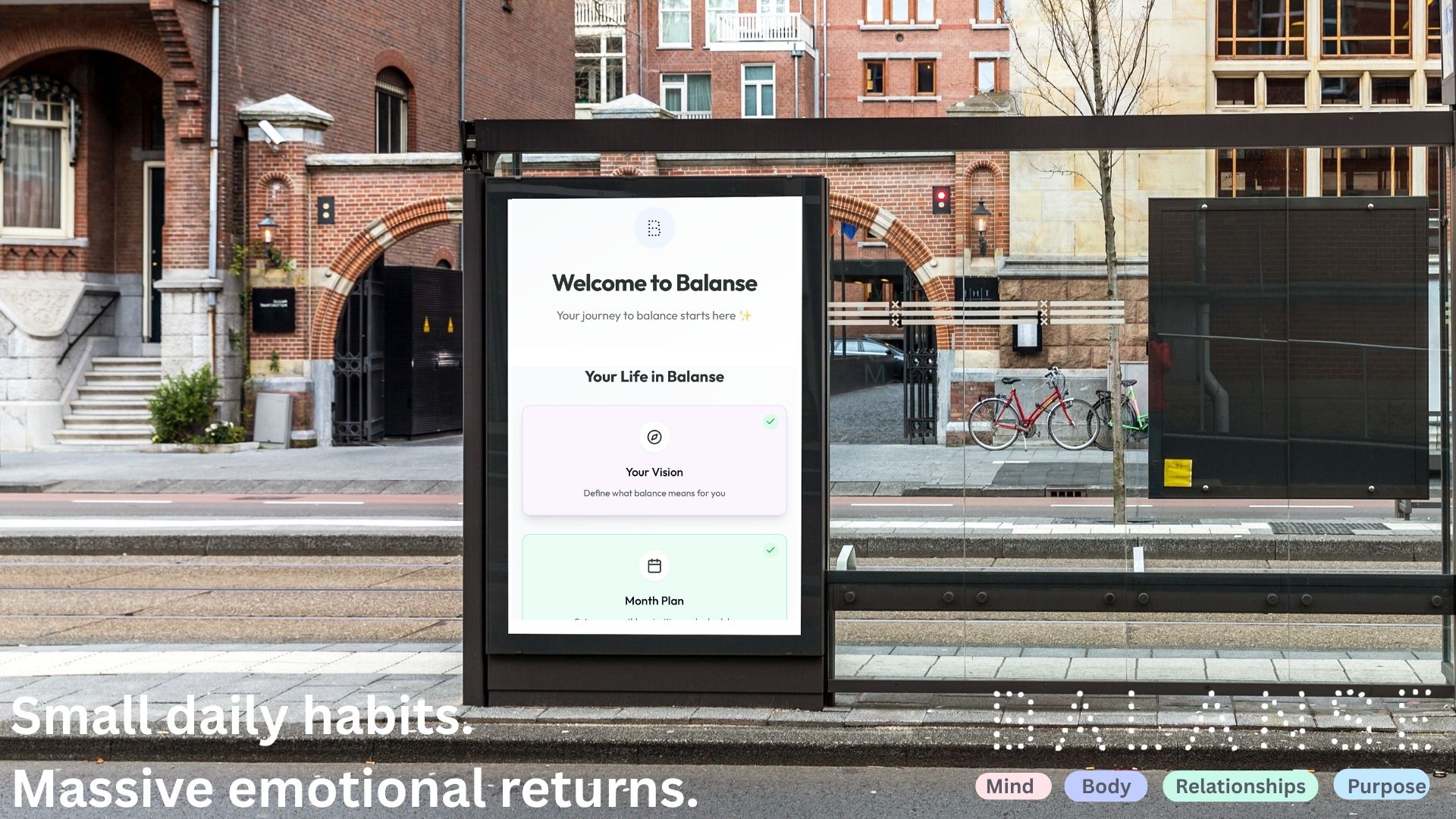
Small daily habits.
Massive emotional returns.
Everything you need to create a life of balance, purpose and fulfilment. Sign up today.