
What should I do when I don't know what's next?
You don't need to know what's next. You just need a question you can actually answer.
What should I do when I don't know what's next?
Live the questions now. Perhaps then, someday far in the future, you will gradually, without even noticing it, live your way into the answer.
Why 'what's next?' keeps failing you
If you've ever stood at the end of something – a job, a degree, a relationship, a chapter – you know the question. What's next? It sounds like an inquiry. It feels like one. But notice what happens when you try to answer it. Nothing.
You sit with it. You stare at the ceiling. You scroll. You ask friends, you read books, you take walks. You wait for clarity to arrive the way weather arrives. It doesn't. And here is why: What's next? isn't really a question. It's a fog. And you can't answer a fog. You can only stand inside one.
Vagueness inflates anxiety. Specificity shrinks it. The brain processes a vague worry as a thousand unsolvable problems at once. It processes a specific worry as one problem with a deadline. Same situation, completely different weight.
'I don't know what to do with my life' is unanswerable. It will loop forever.
'I need to decide by 1 June whether to take the London offer or keep interviewing for two more weeks' is a question. Questions get answered.
The first one feels bigger and heavier. The second one is the one you can actually act on. The size of the question isn't the size of the problem. Usually, the size of the question is the problem.
The Practice: cut until it fits on a Post-it
You don't get clarity by thinking harder about it. You get it by getting closer to what's going on right now. Here is what to do with whatever has been looping in your head lately. Take the loudest worry. Write it down exactly as it shows up: vague, dramatic, universe-sized, all of it. Now ask yourself one question:
What would I actually have to decide or do to make this not loop anymore?
That's the question that cuts. Not what's the answer, but what's the move.
Because the mind isn't really asking 'What am I doing with my life?' it's flinching from the absence of a next step. Give it a next step, and the loop quiets. So you keep rewriting the worry, smaller and closer, until you reach something you could put on a Post-it and do something about by Friday. For example:
→ 'What am I doing with my life?' Fog. There is nothing to decide here, nothing to move.
→ 'What am I doing with this summer?' Still fog. Sounds specific because it has a date on it, but you can't do it. Why? Because the summer isn't one decision, it's a hundred small ones.
→ 'Do I want to spend this summer building something, resting, or exploring?' Closer. Now there is a question with answerable options. But still big.
→ 'This week, do I want to start the book I've been thinking about, plan the trip, sign up for a workshop, or block off real rest time before I decide anything?' There it is. That's a Post-it. You can answer it. You can move on it.
Notice what happened. 'What am I doing with my life?' and 'Should I block off rest time this week?' are technically about the same thing – your life. But one of them is unanswerable and the other gets done by Friday.
Yes, the mind will resist this practice. It will say: 'But the small question isn't important enough, I need to figure out the big thing first.' This is the loop talking. The loop survives on size. Specific questions starve it.
What if I never find my passion?
Passion is its own kind of fog. It promises that somewhere out there is a singular calling, and your job is to find it. If you don't, you've failed, wasted your time. If you do, congratulations, you've arrived, you've made it. Either way, your worth is on the line. That's a lot to put on one word.
I want to offer a different question, a different perspective. Not 'What's my passion?' but 'What adds value to my life?'
What makes time stop for you? What genuinely makes you feel better – fills you with light, excitement, appreciation? Is it creativity? Movement? Being around people who think out loud? Working with your hands? Long conversations? Solitude? Cooking for someone? Walking somewhere new? You probably already know. You just haven't been counting it as enough. Because we've been taught that whatever lights us up has to scale into a career, a calling, an identity or it doesn't count. So we dismiss the things that quietly make us us, and keep searching for some bigger thing that's supposed to make sense of everything.
But the bigger thing isn't out there waiting. It's already in motion every time you do what fills you up. The life worth living isn't built on one passion. It's built on a hundred small returns to what makes you feel alive. So how about instead of finding your passion, you follow what feels like more of you, more often?
For the practice of figuring it out
Dedication: to you, creating your dream life.
We treat figuring it out like another place you arrive at. A job you finally take. A city you finally settle in. A partner you finally meet. There isn't one. The people who look like they have it figured out aren't living without questions. They're just better at naming the next concrete one, and they turned it into a practice.
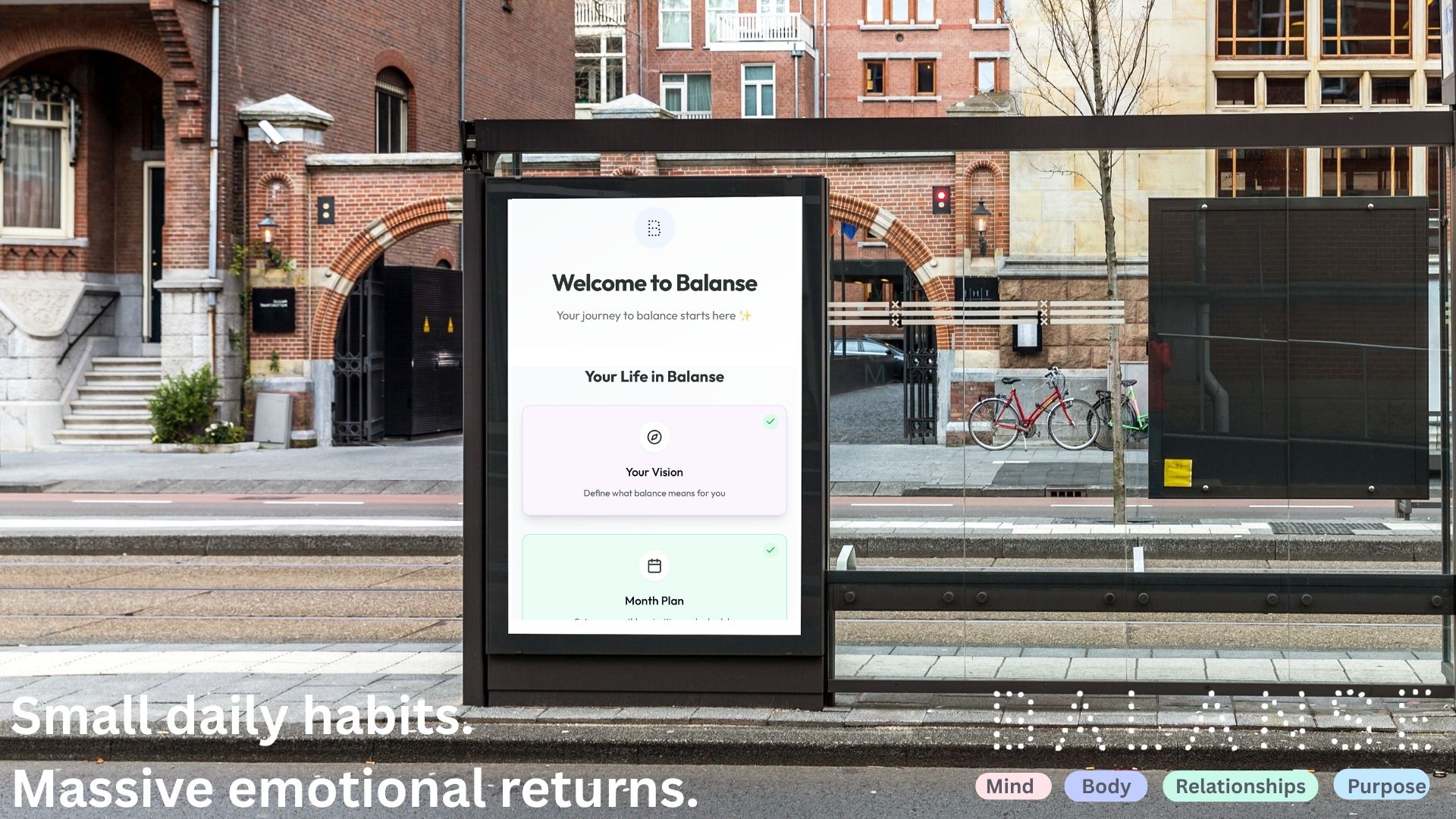
Balanse Coaching and BalanseOS was built for exactly that practice. It's a series of simple, honest questions that help you understand who you are at this point in your life – what you believe, what you value, what moves you, what you want the next 3, 5, and 10 years to actually feel like. The kind of questions that turn fog into vision.
Five minutes in the morning, five at night. Think of it as the doorway in, for anyone just learning how to ask.
Small daily habits.
Massive emotional returns.
Everything you need to create a life of balance, purpose and fulfilment. Sign up today.