
Let your intuition choose the direction
Let your intuition choose the direction. Let reality check the map.
On trusting your gut to find your purpose, and why a business plan won't do it for you
On trusting your gut to find your purpose, and why a business plan won't do it for you
This week I'm speaking to women students and staff at Heriot-Watt University about writing your first business plan. The honest answer to "do you even need one?" is: probably not yet. But preparing the talk made me realise something bigger, and it's not really about business plans at all.
Most business advice starts with the market. What's the gap? How big is the opportunity? What does the data say?
I start somewhere else. I start with you. Because a business that looks good on paper but drains you won't last, and a purpose you've reasoned your way into rarely feels like a purpose at all.
The plan as a permission slip
When I co-founded Sustainably and raised investment in 2019, investors asked for business plans, so I wrote them. Endless days and weeks of them. Most of the rest of my time went on chasing money in a system where all-female founding teams get a tiny share of the funding. In the end we ran out of money, the most common reason startups fail.
Looking back, I can see what a lot of that writing was really for. It wasn't helping me think. It was asking for permission. A 40-page plan can be its own kind of tarot reading: something outside yourself that will finally tell you it's okay to go ahead.
Meanwhile, the things that actually mattered weren't in any document. Which problems kept pulling at me. Which work left me lit up and which left me flat. Who I couldn't stop wanting to help. My intuition knew a great deal. I just didn't treat it as evidence.
Three questions that come before any plan
In the talk, before we get to any frameworks, I ask three questions. Your purpose, and very often your business, lives where they overlap.
1. What am I good at? Not what you've got qualifications in. What do people already come to you for? What have you been paid for before, even informally?
2. What regulates my nervous system? Which work leaves you calmer and more energised rather than drained? This is intuition through the body. You'll be doing this work for years, so it matters more than almost anything on a spreadsheet.
3. Where am I being called to help? This is the pure intuition question. The problem you can't stop noticing. The people you keep wanting to help even when nobody's paying you. The injustice that makes your jaw tighten.
If you're not sure, look at your history. What have you been quietly doing for years without calling it anything? That's usually the clue.
Intuition is data you haven't written down yet
We tend to treat intuition as the soft, unreliable cousin of analysis. It isn't. It's pattern recognition: every job you've done, every person you've helped, every moment you thought this isn't right or this matters, distilled into a signal that arrives before you can explain it.
When something keeps tugging at you, that's not random. Your experience is pointing at something before your logic has caught up. For me, that pull led to Balanse: women who look fine on paper and are quietly burning out. I'd lived it, I'd watched it in teams I led, and I couldn't stop seeing it. No market report told me to go there. My gut did.
But your gut doesn't get the final say
Here's the part I'll be just as honest about with the students tomorrow: intuition chooses the direction. It doesn't confirm the destination.
Wanting something badly is necessary. It isn't enough. Plenty of founders who wanted it with their whole heart still failed. What decides the outcome is far less romantic: whether customers will pay, whether the cash lasts, and timing.
I learned that one at CodeClan. I arrived to one month of cash. We changed the business model, the operating model and the team's skills, and bought nine more months. Then the funding was withdrawn across the sector, the market contracted and it closed. No amount of belief could have changed the timing.
So once your intuition has pointed you somewhere, test it in the real world. The test I use is simple: is this a painkiller someone will pay for this month, or a vitamin they'll mean to buy someday? The only real verdict is someone paying you.
And remember that not every strong feeling is intuition. Sometimes it's fear dressed up as caution ("I'm not ready"). Sometimes it's a wish dressed up as certainty ("everyone will want this"). Real intuition tends to feel quiet, clear and a bit inconvenient. Fear and fantasy are both loud.
How to do both
Trusting your gut and testing it aren't opposites. They're a loop. Here's how to start:
Notice what you keep noticing. For two weeks, jot down every time a problem catches your attention or you feel a pull to help someone. Patterns appear quickly.
Do the body check. After each piece of work, ask: did that drain me or fill me up? Your nervous system is telling you where you can last.
Write one page, not forty. Put your intuition into words: the problem, who has it, what you'd offer first. Then add the box most people skip: what would prove me wrong?
Make something small and give it away. A guide, a session, a simple tool. Every person who tries it is research.
Talk to five people this week. Not friends being kind. People with the problem. Their answers will sharpen your purpose faster than any template.
Your purpose isn't in a document
You won't find your purpose by writing a better plan, and you won't find it by waiting for a sign. You find it by following the pull, taking a small step, and paying attention to what comes back.
Your intuition has been collecting evidence your whole life. Let it choose the direction. Then let the real world, and real people, help you draw the map.
Your next step
Start with Workbook 1: Your Vision Comes First, free on the Balanse site. It's built to help you hear what you actually want, before anyone else's opinion gets a vote.
Because your day creates your life.
Listen in
Short, honest episodes to help you pause, reset and choose your next step.
Listen to the Daily Reset podcast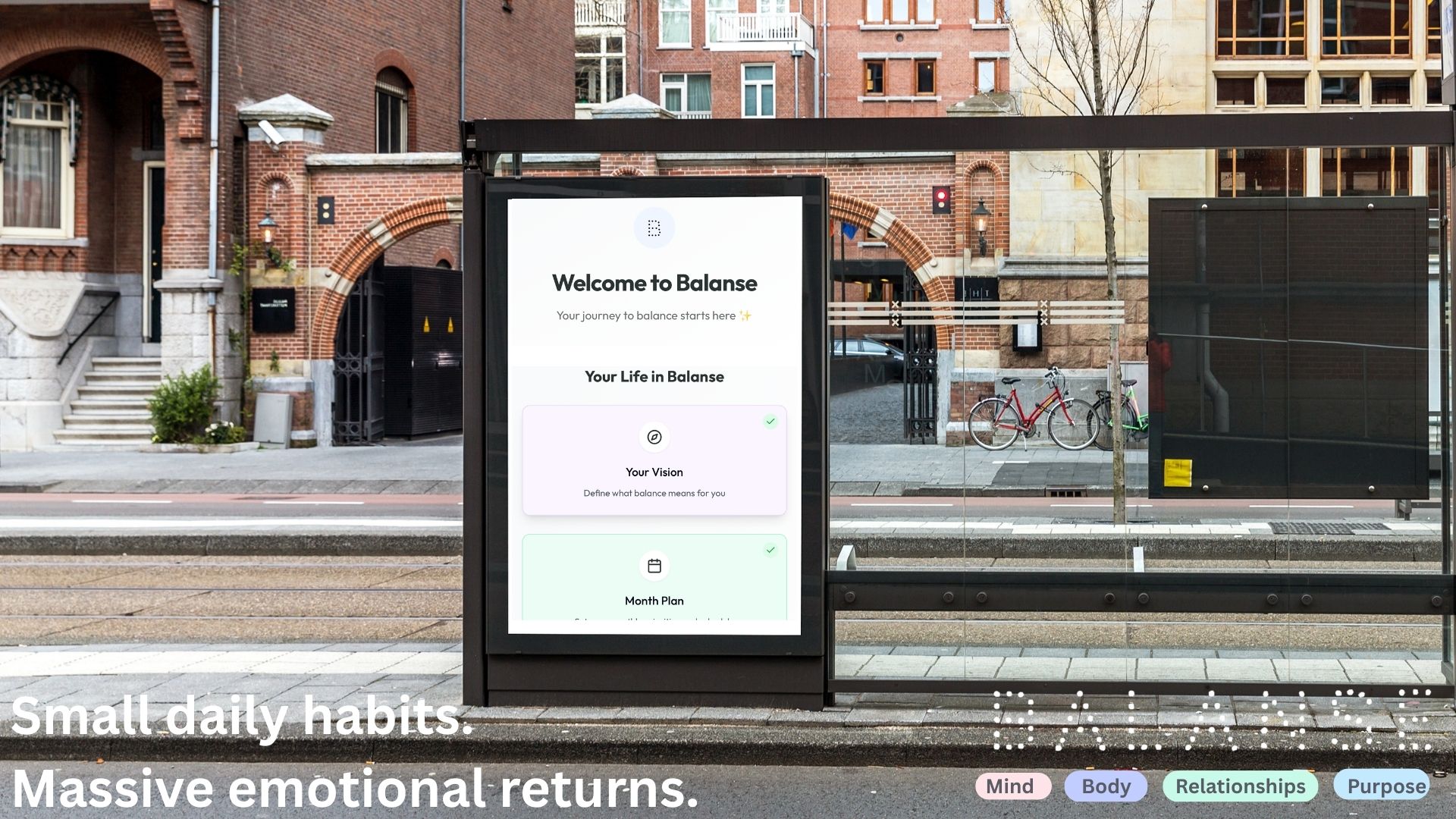

Small daily habits.
Massive emotional returns.
Everything you need to create a life of balance, purpose and fulfilment. Sign up today.