
You don't need more confidence
You don't need more confidence. You need less translation.
On self-belief, and finding the voice you already have
On self-belief, and finding the voice you already have
You know the moment. You're in a meeting, or a family conversation, or typing a message to someone who matters. A thought arrives, clear and complete. And then, before it reaches your mouth, it goes through customs.
Is that too much? Too blunt? Will they think I'm difficult? Should I soften it? Add a question mark? Lead with "I might be wrong, but…"?
By the time it comes out, it's been translated into something safer, smaller and slightly beside the point. And afterwards you replay it and think: why didn't I just say what I meant?
Most of the women I work with don't lack opinions, intelligence or experience. They have decades of it. What they've built, very skilfully, is a translation habit. And that habit is quietly exhausting.
Self-belief isn't a feeling you wait for
We tend to imagine that confident people feel certain first and act second. So we wait. We wait until we feel ready, until we've done one more course, until the timing is right.
It doesn't work that way. Self-belief isn't a mood that arrives. It's a record you build.
Every time you say you'll do something and do it, you add to the evidence. Every time you speak up and the world doesn't end, you add to the evidence. Every time you abandon a promise to yourself to keep the peace for someone else, you quietly subtract from it.
This is why so many capable women feel shaky inside despite impressive CVs. Their record of keeping promises to other people is excellent. Their record of keeping promises to themselves is patchy. Self-belief tracks the second one.
Your voice isn't lost. It's been edited.
"Finding your authentic voice" can sound like a quest, as if it's buried somewhere and you need a retreat in the mountains to dig it up.
I don't think it's lost. I think it's been edited down, one reasonable compromise at a time.
You learned to say "I'm fine" because it was quicker than explaining. (I call myself a recovering fine-aholic for a reason.) You learned to present the version of the idea that would get approved rather than the one you believed in. You learned to read the room so well that you stopped hearing yourself in it.
None of that was stupid. A lot of it kept you safe, kept things moving, got you promoted. But somewhere along the way, the edit became the default. Finding your voice is less about discovery and more about subtraction: noticing what you take out, and choosing to leave some of it in.
You already know. You've just been taught not to trust it.
If there's one edit that runs deeper than all the others, it's this one: as women, many of us have learned not to trust our own intuition.
We were told we were being emotional, oversensitive, irrational. We learned that a feeling didn't count until we could justify it with a spreadsheet, a second opinion or someone more senior nodding along. So we got very good at overriding the quiet voice that said something's not right here, or this is the one, and then watching, months later, as it turned out to have been right all along.
Intuition isn't magic and it isn't nonsense. It's pattern recognition. It's every meeting you've sat in, every person you've read, every decision you've lived with, distilled into a signal that arrives faster than logic can. And by midlife, you have more of that data than you've ever had. Your gut has never been better informed. It's your trust in it that's been worn down.
Looking for permission
So we go looking for permission somewhere else. Horoscopes. Tarot. Crystals. Readings. Anything that will tell us it's okay to want what we want, or to leave what we need to leave.
I'll be honest: I love all of that too. I'm not here to tell you to throw out your cards or your crystals. They can be beautiful rituals, and they can create a pause in which you actually listen to yourself.
But notice what happens when you pull a card or read your stars. Before you've even interpreted it, you feel something: relief, or a little sink of disappointment. That reaction is the answer. The card didn't tell you. It just gave you a moment quiet enough to hear what you already knew.
Use them as a mirror, not a permission slip. The goal isn't to need nothing outside yourself. It's to stop outsourcing the final say. Trusting your intuition is self-belief in its most practical form: taking your own knowing seriously enough to act on it.
One honest caveat, though: not every gut feeling is intuition. Especially if you're coming out of a long stretch of burnout, the "no" in your stomach can sometimes be fear, people-pleasing or an old rule you learned long ago, dressed up as wisdom. A rough way to tell them apart: intuition tends to feel calm and clear, even when what it's telling you is inconvenient. Fear feels urgent, tight and loud, and it usually wants you to make yourself smaller. If the feeling is quietly certain, listen. If it's frantic and keeps you small, get curious about where it came from before you obey it.
What I learned the hard way
I've led teams through restructures, turnarounds and some very difficult news. When I joined a business that had around one month of cash left, I believed my job was to sound certain at all times.
What actually helped people wasn't my certainty. It was my honesty: saying what I knew, what I didn't, and what we were going to do next. The moments I translated myself into "corporate calm" were the moments people trusted me least. The moments I spoke plainly were the ones that moved things.
I've also spent a year of my life writing business plans and chasing investment, shaping my story around what I thought investors wanted to hear. That taught me what it costs to perform a version of yourself for long enough. You get very good at the performance, and very tired.
Where the edit shows up
At Balanse we work across four areas of life: mind, body, relationships and purpose. The translation habit shows up in all of them.
• Mind: the inner commentary that rewrites your thoughts before you've finished having them.
• Body: the held breath, tight jaw and racing heart before you speak, and the slump after you didn't.
• Relationships: saying yes when you mean no, and resenting it later.
• Purpose: pursuing the goal you can justify rather than the one you actually want.
If one of those made you wince, that's useful information. Start there.
Five small practices
You don't need a personality transplant. You need repetitions.
1. Catch the first draft. For one week, notice the gap between the sentence you thought and the sentence you said. Don't fix it yet. Just notice. Write a few down in the evening. Patterns appear fast.
2. Keep one tiny promise to yourself every day. Make it almost embarrassingly small: a ten-minute walk, a glass of water before coffee, closing the laptop at six. You're not building a habit. You're building evidence that your word to yourself counts.
3. Say one unedited true thing a week. Choose someone safe. Say what you actually think or want, without the softener at the front or the question mark at the end. "I'd like to do it this way." "That doesn't work for me." "I want this." Then notice what happens. Usually: much less than you feared.
4. Breathe before you speak. Your voice lives in your body. One slow breath out, longer than the breath in, before an important sentence. It tells your nervous system you're not under attack, and it gives your real words a moment to arrive.
5. Ask yourself first. Before you reach for a card, a reading or a friend's opinion, write down what you think the answer is. One line. Then go ahead and pull the card or make the call. Keep a note of how often your first answer was right. That list becomes the evidence your self-belief has been waiting for.
Ask for what you want
Here is the uncomfortable truth underneath all of this: you can't ask for what you want if you've stopped letting yourself know what you want.
Self-belief and an authentic voice grow together. You say one true thing, you survive it, you believe yourself a little more, so you say the next true thing a little sooner. That's the whole mechanism. It's not glamorous. It works.
You don't need to become someone louder, harder or more polished. You need to stop translating the woman who's already here.
Your next step
If this resonates, start with Workbook 01: Vision, free on the Balanse site. It's a quiet hour with yourself to get clear on what you actually want, before the edit kicks in.
And if you'd rather not do this alone, The Balanse Journey starts on 11 January 2027: twelve weeks with a small group of women doing exactly this work, with accountability built in.
Because your day creates your life.
Start with your vision
A free workbook to explore your values and the life you want, at your own pace.
Start with Your Vision Comes First, free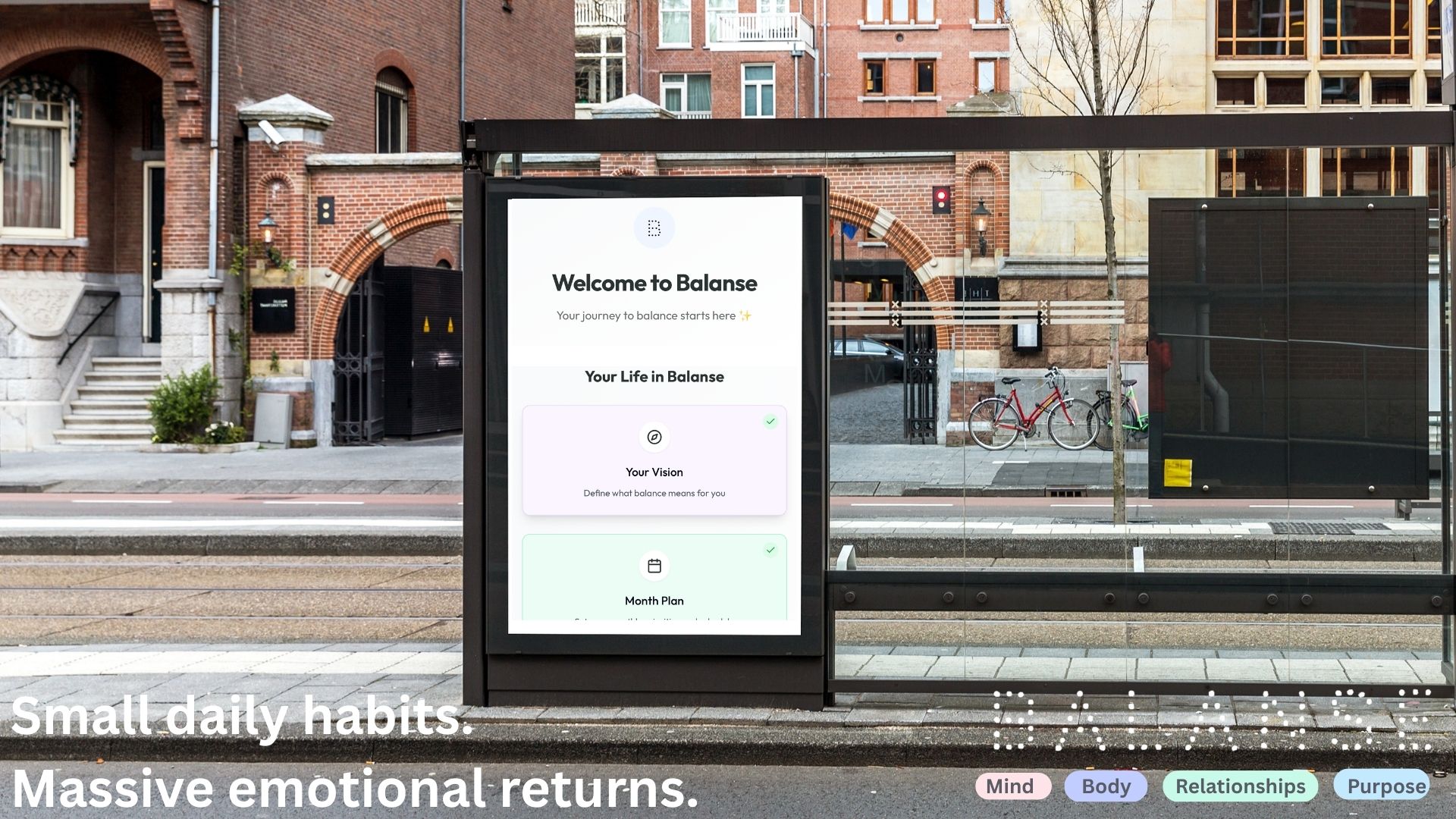

Small daily habits.
Massive emotional returns.
Everything you need to create a life of balance, purpose and fulfilment. Sign up today.